Rath Yatra, Puri — June / July
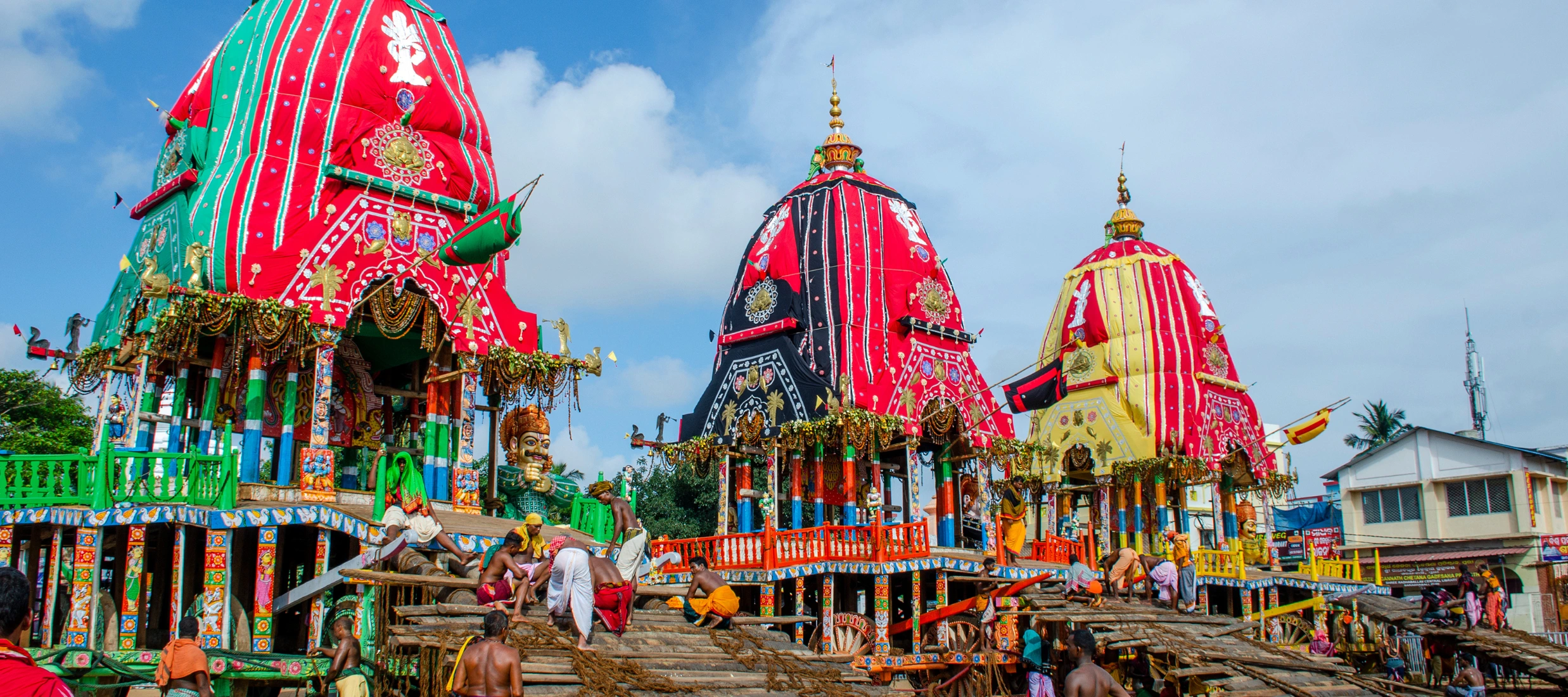
In the coastal town of Puri, Odisha, the mood begins to change days before anything moves. People gather slowly, conversations soften, and the streets start to feel like they are waiting. By the time Rath Yatra arrives, the town is already in motion.
The festival traces its roots to antiquity, described in sacred texts like the Brahma Purana and Skanda Purana, and marks the annual journey of Lord Jagannath, along with his siblings Balabhadra and Subhadra, from the Jagannath Temple to the Gundicha Temple, roughly two kilometres away. What makes this journey extraordinary is its radical openness. The deities leave the inner sanctum and come out into the streets, where anyone, regardless of caste, faith, or background, can see them, walk alongside them, and pull the ropes.
Each year, three towering wooden chariots are built entirely from scratch using traditional methods passed down through generations. Lord Jagannath’s chariot, Nandighosa, stands over 45 feet high on 18 wheels. When the ropes are pulled, thousands move together in quiet faith, believing the act itself carries blessings. Before the procession begins, the Gajapati King of Puri performs Chhera Pahara, sweeping the chariot floor with a golden broom, a gesture that reminds everyone present that in devotion, no one stands above another.
For visitors, there are few sights in India quite like watching those three great chariots lurch forward, pulled by a sea of hands, as Puri erupts in one long, collective breath.
FESTIVAL ARCHIVE
December +-
November +-
October +-
September +-
August +-
July +-
June +-
May +-
April +-
March +-
February +-
January +-
Follow us on Instagram
@indiabycreative