Kumbh Mela — Dates vary by city and cycle
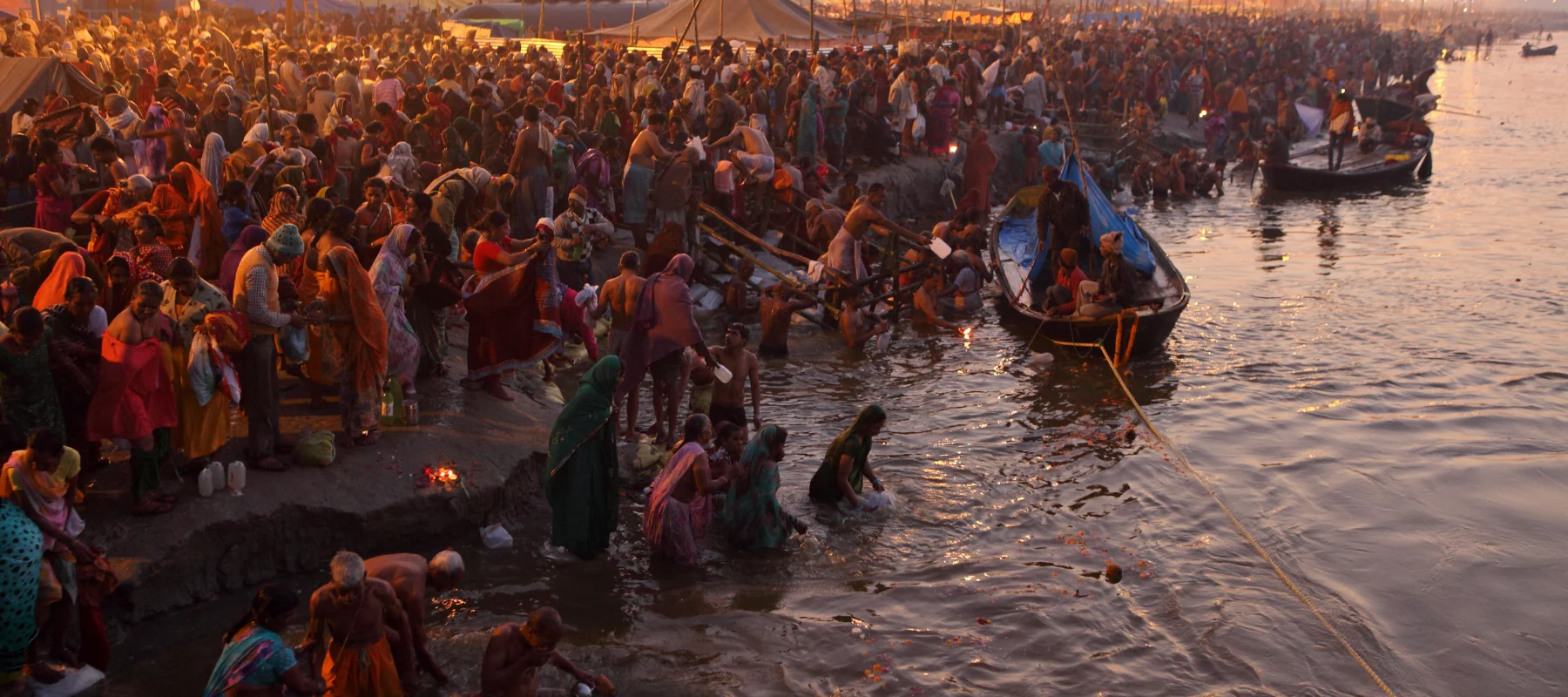
Somewhere between myth and mathematics, the Kumbh Mela exists. It is the largest peaceful human gathering on earth, a congregation so vast that no stadium, no city, no satellite image can fully contain it. At the most recent Maha Kumbh in Prayagraj in early 2025, over 660 million people gathered over 45 days, a number that exceeds the entire population of the United States twice over.
The festival traces its origins to one of Hinduism’s most ancient stories: the Samudra Manthan, or the churning of the cosmic ocean, during which gods and demons fought for possession of amrit, the nectar of immortality.
As the divine pot was carried across the heavens, drops of nectar fell on four places on earth: Prayagraj, Haridwar, Ujjain, and Nashik. These are the four sacred cities that take turns hosting the Kumbh, each location tied to a specific river: the Ganga and Yamuna at Prayagraj, the Ganga at Haridwar, the Shipra at Ujjain, and the Godavari at Nashik.
The timing of each Kumbh is calculated through ancient Hindu astrology, determined by the positions of the Sun, Moon, and Jupiter in particular zodiac signs. The cycle rotates across the four cities roughly every three years, while a Purna Kumbh at each city occurs every twelve years.
The rarest of all is the Maha Kumbh Mela, held only at Prayagraj once every 144 years, after twelve full Purna Kumbh cycles. An Ardh Kumbh, or half Kumbh, is held every six years at Prayagraj and Haridwar. The next Kumbh Mela is set for Nashik in 2027, followed by Haridwar in 2028.
At the heart of every Kumbh is the ritual of the holy dip. Devotees believe that bathing in the sacred river at the most auspicious moment cleanses all sin and breaks the cycle of birth, death, and rebirth. The Shahi Snan, or royal bathing procession, sees thousands of naked Naga sadhus, ash-smeared and trident-bearing, descend to the river in a procession of extraordinary spectacle. Alongside them come kalpavasis who live on the riverbank for weeks, akhadas of warrior monks, wandering mystics, and millions of ordinary pilgrims who have travelled for days to be there.
For a visitor, the Kumbh Mela is not simply a festival. It is a confrontation with scale, with faith, and with the strange, overwhelming beauty of millions of people moving together toward the same water.
FESTIVAL ARCHIVE
December +-
November +-
October +-
September +-
August +-
July +-
June +-
May +-
April +-
March +-
February +-
January +-
Follow us on Instagram
@indiabycreative